Coursework project / Computer vision
Skin-lesion classification
Learning how to train a model—and question its evaluation.
The work
Compared a custom convolutional neural network with a partially fine-tuned ResNet18 for binary skin-lesion classification. Experiments included augmentation and training settings.
Coursework used the Kaggle Melanoma Cancer Image Dataset, with 224 × 224 RGB inputs and benign/malignant labels.
The evaluation boundary
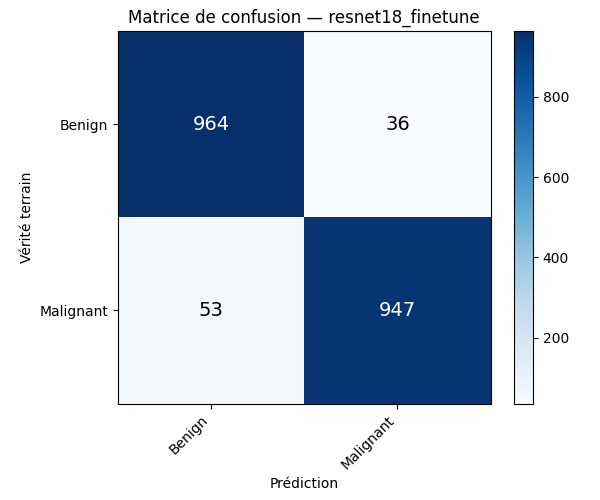
ResNet18 classified 1,911 of 2,000 evaluation images correctly (95.55%). That set was used during development, so this is an exploratory result, not an unbiased estimate of performance on unseen data.
The evaluation set contains 1,000 benign and 1,000 malignant images. The confusion matrix shows 36 benign images classified as malignant and 53 malignant images classified as benign. Those errors matter even when the aggregate accuracy looks high.
What I learned
Training and evaluating image models in PyTorch, examining classification errors—including false negatives—and being precise about what an evaluation can actually establish. This was not a clinically validated diagnostic system.
A useful result needs an equally clear description of how it was measured.